'Creamorous' and other blends
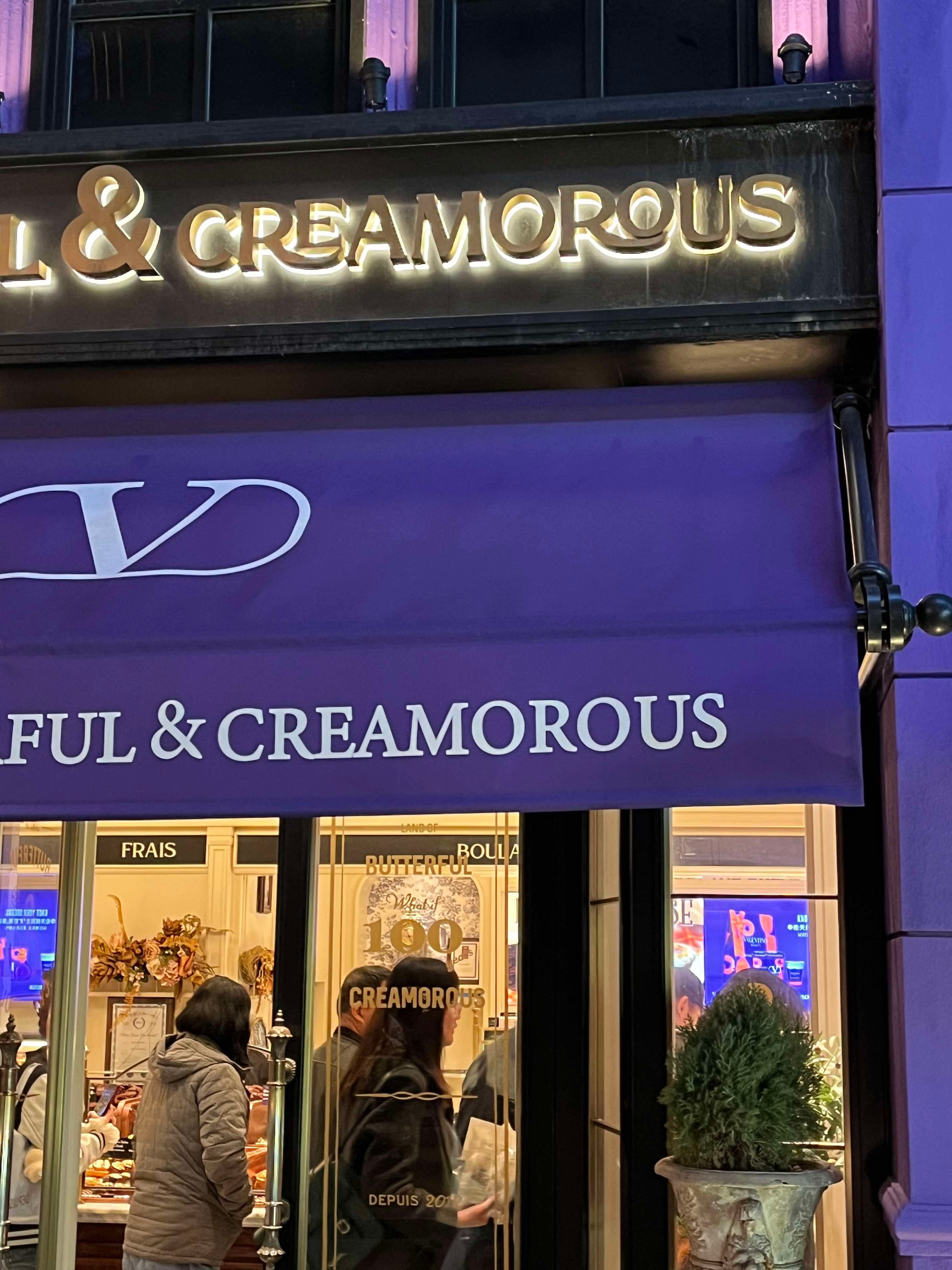
My friend F recently sent me this interesting photo of a shopfront somewhere in Asia (China, maybe?), showing the use of a novel blend 'CREAMOROUS' -- formed (I'm assuming) from 'cream' + '(glam)orous'. The photo also shows the ending of the previous word: '...FUL &'. Initially, I thought the full version might've been 'BEAUTIFUL & CREAMOROUS', which made me think the place was some kind of beauty salon or shop, probably thanks to the similarity to 'glamorous'. After a simple search, it turns out it's a patisserie with the name 'BUTTERFUL & CREAMOROUS'. Two blends! The first is probably 'butter' + '(beauti)ful'. I find 'creamorous' to be extremely funny for some reason. I checked a few English corpora for these, and very few results returned. 'Butterful' showed up a handful of times in the News On the Web (NOW) corpus (~20 billion words), with 'creamorous' appearing only once -- in a review of Butterful & Creamorous. So, they're pretty novel, at least in the corpora I checked.
Besides being neat cases of linguistic innovation, blends are a common source of what Martin Haspelmath calls 'secretion', and what Arnold Zwicky calls (more cleverly) 'libfixation'. Libfixation occurs when speakers interpret a string of segments that did not originally constitute a morpheme as a morpheme, specifically an affix, which they then attach to new roots to form novel words. This often happens when multiple blends are formed from the same source and therefore share a common component, which allows speakers to abstract away from the variable component to a more generic pattern. The shared element can then be reinterpreted as attachable to any (suitable) base. One of the most famous examples of this is /-(ə)hɔlɪk/: alcoholic > {work|shop|...}aholic > X-(a)holic. Since this process is largely complete, X-aholic now means 'one who is addicted to X'. An example of this I came across last year is from a (now defunct) dumpling shop on Grattan Street, called 'DimSimHolic' (pictured below).
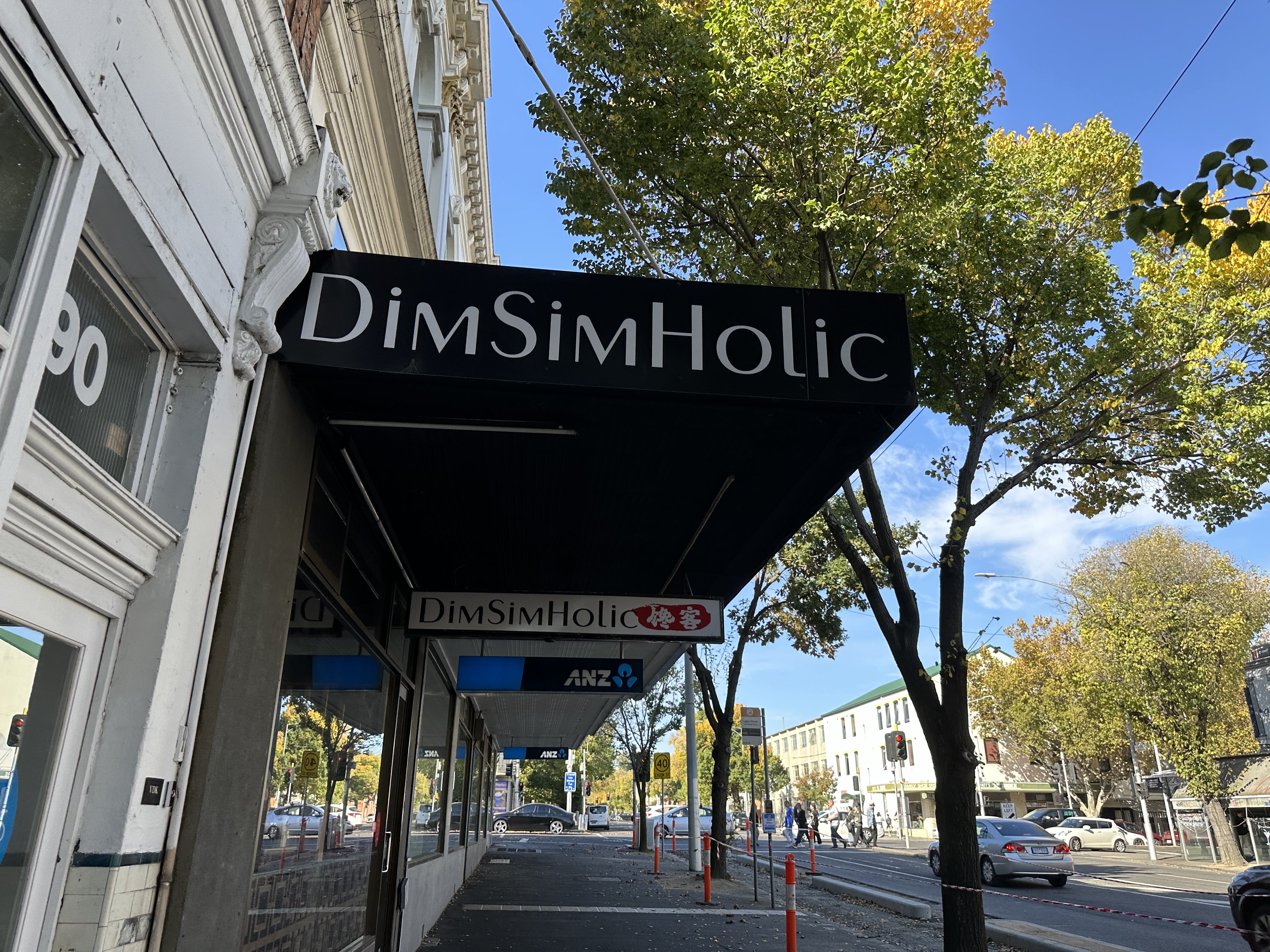
What's interesting about this one is that, to me, it's phonologically ill-formed. While it's generally true that /-hɔlɪk/ prefers to follow a (disyllabic) foot, such as [ælkə] or [wɜkə], it also prefers to follow a weak syllable, especially one that ends in a schwa (i.e., [kɛ], which is unaccented and ends in [ə]). Thus, whilst /dɪmsɪm/ is indeed a foot, its second syllable is both accented and consonant-final, therefore constituting a sub-optimal base for /-hɔlɪk/. We could try to repair this situation by epenthesising [ə] between /dɪmsɪm/ and /-hɔlɪk/, which would result in [dɪmsɪməhɔlɪk]. Now, [hɔlɪk] is preceded by the desired trochaic foot in [sɪmə], however the consequence of doing this makes the base trisyllabic -- [dɪmsɪmə] -- and that doesn't sound very good either. So, it would seem that there are both prosodic and segmental preferences regarding the phonology of the base to which /-(ə)hɔlɪk/ attaches: (a) the base should be a trochaic foot; (b) the base should end in a schwa. We can see that bases which defy either or both of the above preferences sound pretty awkward, even when a schwa is epenthesised to form a pre-[hɔlɪk] trochee:
- ?[əspatæɪm(ə)hɔlɪk] 'aspartame-(a)-holic'
- ?[vɔliboːl(ə)hɔlɪk] 'volleyball-(a)-holic'
- ?[pæɹəs(ə)hɔlɪk] 'Paris-(a)-holic'
The reason for this dispreference is that, in many ways, libfixes lie somewhere in between being true affixes and being components of a blend. Whilst many libfix constructions involve attaching the libfix to a complete word, making the libfix morphologically affix-like, there is a tendency for these constructions to resemble or even match the prosody of the source word from which the libfix originates. Such prosodic requirements make those constructions more blend-like, since derivational affixes in English don't usually select for the size of the base (to my knowledge, at least). However, there are more conventionalised libfixes, such as '-dar', that do not come packaged with as strict prosodic restrictions on the base and are therefore might be considered truer affixes.
Anyway, these are just a few throwaway thoughts about blends, libfixes, and some English phonology. What I'm hoping for is that '-orous' catches on and becomes a libfix of its own: X-orous, 'the property of exhibiting (lots of) X'. Taken to mean just that, you can imagine why 'Beautiful & Creamorous' would be a very strange name for a beauty shop.
# Footnotes
Martin Haspelmath, "The Growth of Affixes in Morphological Reanalysis," in Yearbook of Morphology, eds. Geert Booij and Jaap Marle (Springer, 1995), 8-10, DOI: 10.1007/978-94-017-3714-2_1.
Camiel Hamans, "Prosodic aspects of non-morphemic word formation," Scripta Neophilologica Posnaniensia 24 (Dec 2024): 15n8, DOI: 10.14746/snp.2024.24.01.

I suspect the reason for this is that it remains phonologically closer to the source of the libfix in /ælkəhɔlɪk/, whose first foot ends in a schwa. Schwa is also the default epenthetic vowel when the base is monosyllabic: /ʃɔpəhɔlɪk/ 'shop-a-holic'. To illustrate that a base-final schwa really is the most optimal final segment, compare the following two possible constructions: /bʌɾə-hɔlɪk/ 'butterholic' versus /paɾi-hɔlɪk/ 'partyholic'. To me, the former sounds far better than the latter, despite both bases being prosodically equivalent.
For some brief discussion of the prosody of libfix constructions, see Hamans, "Prosodic aspects of non-morphemic word formation," 15-18.
For instance, we find libfix constructions like 'sarcasm-dar' and 'redneck-dar', which have bases that, in virtue of being disyllabic, are larger than the content replaced in the source word (in this case, the monosyllable /ɹæɪ/ in /ɹæɪ.daː/).