My friend FK recently sent me this interesting photo of a shopfront somewhere in Asia (China, I deduced), showing the use of a novel blend ‘creamorous’ – formed (I’m assuming) from ‘cream’ + ‘(glam)orous’. The photo also shows the ending of the previous word: ‘…FUL &’. Initially, I thought the full version might’ve been Beautiful & Creamorous, which made me think the place was some kind of beauty salon or shop, probably thanks to the similarity to ‘glamorous’. After a simple search, it turns out it’s a patisserie with the name Butterful & Creamorous. Two blends! The first is probably ‘butter’ + ‘(beauti)ful’.Well, this could also be interpreted as the suffix -ful, as in the words plenti-ful, beauti-ful, power-ful, and so on. But the fact that Creamorous is clearly a blend tips the balance in favour of a blend analysis of Butterful. I find creamorous to be extremely funny for some reason. I checked a few English corpora for these, and very few results returned. ‘Butterful’ showed up a handful of times in the News On the Web (NOW) corpus (~20 billion words), with ‘creamorous’ appearing only once – in a review of Butterful & Creamorous. So, they’re pretty novel, at least in the corpora I checked.
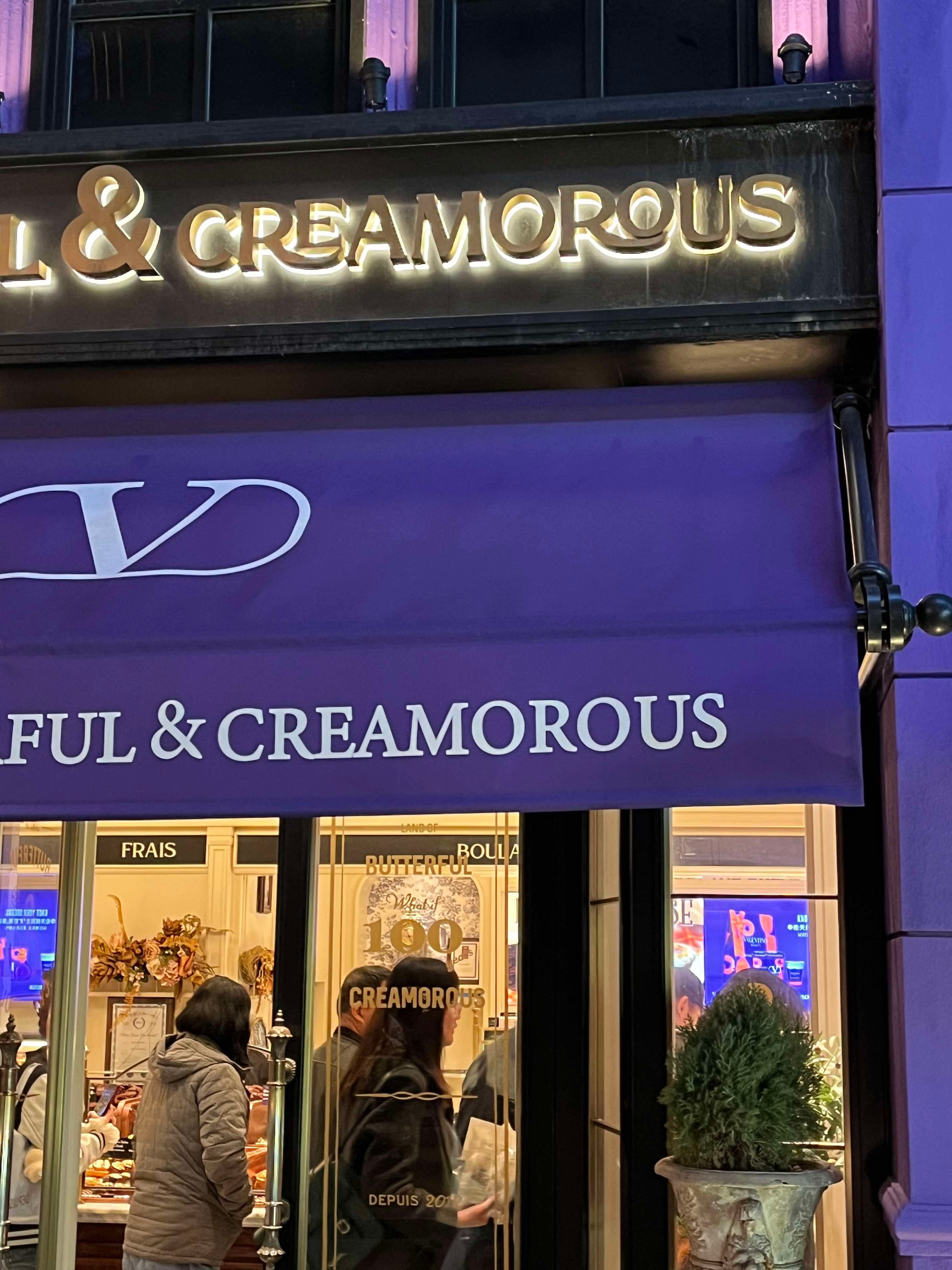
Besides being neat cases of linguistic innovation, blends are a common source of what Martin Haspelmath calls ‘secretion’,
Martin Haspelmath, “The Growth of Affixes in Morphological Reanalysis,” in Yearbook of Morphology, eds. Geert Booij and Jaap Marle (Springer, 1995), 8-10, DOI: 10.1007/978-94-017-3714-2_1.
and what Arnold Zwicky calls ‘libfixation’. Libfixation occurs when speakers interpret a string of segments that did not originally constitute a morpheme as a morpheme, specifically an affix, which they then attach to new roots to form novel words. This often happens when multiple blends are formed from the same source and therefore share a common component, which allows speakers to abstract away from the variable component to a more generic pattern. The shared element can then be reinterpreted as attachable to any (suitable) base.Camiel Hamans, “Prosodic aspects of non-morphemic word formation,” Scripta Neophilologica Posnaniensia 24 (Dec 2024): 15n8, DOI: 10.14746/snp.2024.24.01:
“Libfixing does not necessarily require reanalysis of one opaque form. It is also possible that a libfix is the result of a few more or less similar forms, as in Pakistan, Kurdistan, Afghanistan, and Uzbekistan. These names gave rise to the libfix -istan, as in Londonistan, divorcistan, dum(b)fuckistan and girlistan.” (p. 15)
One of the famous examples of this is /-(ə)hɔlık/: alcoholic > {shop | work | …}aholic > X-(a)holic. Since this process is largely complete, X-aholic now means ‘one who is addicted to X’. An example of this I came across last year is from a (now defunct) dumpling shop on Grattan Street, called DimSimHolic (pictured below).
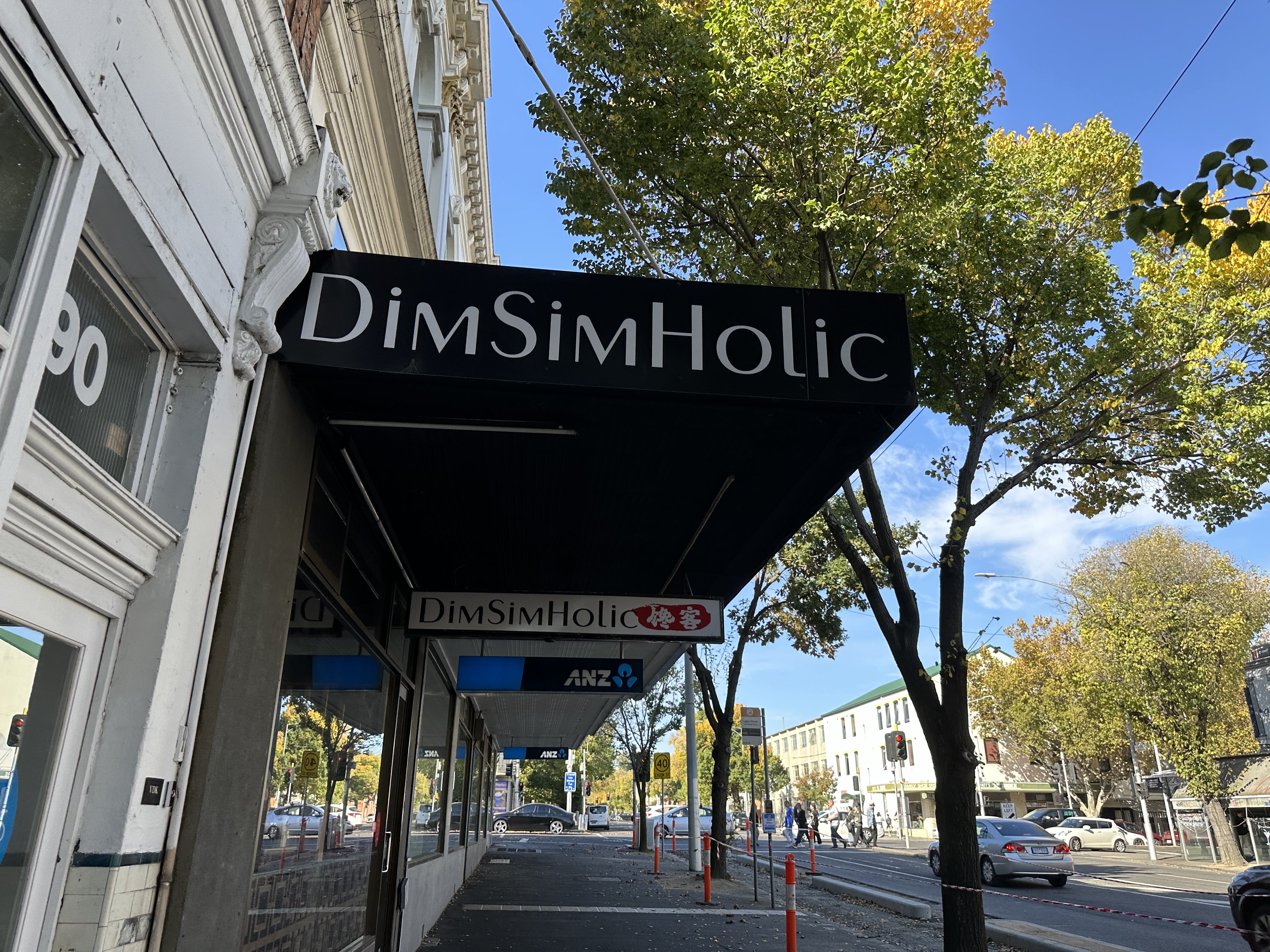
What’s interesting about this one is that, to me, it’s phonologically ill-formed (or suboptimal, if you like). While it’s generally true that /-hɔlık/ prefers to follow a (bisyllabic) foot, such as [ælkɐ] or [wɜːkɐ], it also prefers to follow a weak syllable, especially one that ends in a schwa or unstressed low vowel [ə ~ ɐ].I suspect the reason for this is that it remains phonologically closer to the source of the libfix in /ælkɐhɔlık/, whose first foot ends in [ə ~ ɐ]. (In my variety of English, this vowel is [ɐ] so I use it in this post where American readers might expect [ə], for example in unstressed syllables.) The [ɐ] vowel is also the default epenthetic vowel when the base is monosyllabic: [ʃɔp-ɐ-hɔlık] ‘shop-a-holic’. To illustrate that a base-final [ɐ] really is the most optimal final segment, compare the following two possible constructions: [bɐɾɐ-hɔlık] ‘butterholic’ versus [pɐːɾi-hɔlık] ‘partyholic’. To me, the former sounds far better than the latter, despite both bases being prosodically equivalent. Thus, whilst /ˌdımˈsım/ is indeed a foot, its second syllable is both stressed and consonant-final, therefore constituting a sub-optimal environment for /-hɔlık/. We could try to repair this situation by epenthesising [ɐ] between /dımsım/ and /-hɔlık/, which would result in [dımsımɐhɔlık]. Now [hɔlık] is preceded by the desired light foot in [sımɐ], however the consequence of doing this makes the base trisyllabic – [dımsımɐ] – and that doesn’t sound very good either. So, it would seem that there are both prosodic and segmental preferences regarding the phonology of the base to which /-(ɐ)hɔlık/ attaches: (a) the base should be a trochaic foot; (b) the base should end in an unstressed schwa or central low vowel. We can see that bases which defy either or both of the above preferences sound pretty awkward, even when [ɐ] is epenthesised to form a pre-/hɔlɪk/ trochee:
- ?[əspɐːtæım(ɐ)hɔlɪk] aspartame-holic ~ aspartame-a-holic
- ?[vɔliboːl(ɐ)hɔlık] volleyball-holic ~ volleyball-a-holic
- ?[pæɹəs(ɐ)hɔlık] Paris-holic ~ Paris-a-holic
The reason for this dispreference is that, in many ways, libfixes lie somewhere in between being true affixes and being components of a blend. Whilst many libfix constructions involve attaching the libfix to a complete word, making the libfix morphologically affix-like, there is a tendency for these constructions to resemble or even exactly match the prosody of the source word from which the libfix originates.For some brief discussion of the prosody of libfix constructions, see Hamans, “Prosodic aspects of non-morphemic word formation,” pp. 15-18. Such prosodic requirements make those constructions more blend-like, since derivational affixes in English don’t usually select for the size of the base (to my knowledge, at least). However, there are more conventionalised libfixes, such as ‘-dar’, that do not come packaged with as strict prosodic restrictions on the base and are therefore might be considered truer affixes.For instance, we find (possibly questionable) libfix constructions like ‘sarcasm-dar’ and ‘redneck-dar’, which have bases that, in virtue of being disyllabic, are larger than the content replaced in the source word (in this case, the monosyllable /ɹæı/ in /ɹæı.dɐː/).
Anyway, these are just a few throwaway thoughts about blends, libfixes, and some English phonology. What I’m hoping for is that ‘-orous’ catches on and becomes a libfix of its own: X-orous, ’the property of exhibiting (lots of) X’. Taken to mean just that, you can imagine why Beautiful & Creamorous would be a very strange name for a beauty shop.